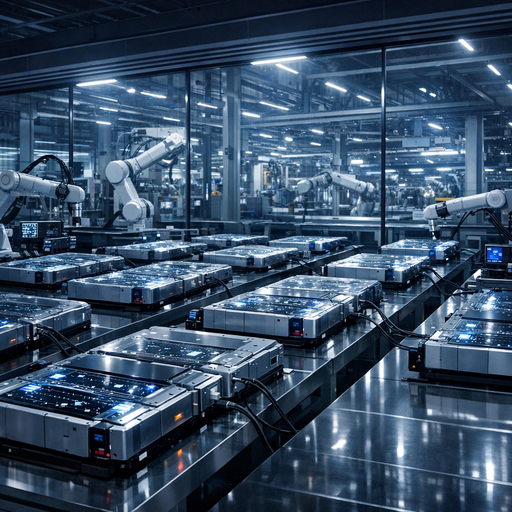

Solid-State Batteries Are Finally Leaving the Lab. Here’s the Real Timeline (and Why ML Teams Should Care)
Why this matters right now
If you’re building or running ML-heavy systems, you already feel the constraints of physical infrastructure: power density, cooling, latency, and increasingly, grid availability.
Solid-state batteries (SSBs) sound like someone else’s problem—EVs, mobility, “the car guys.” But if even half of the realistic claims land, they’ll directly affect:
- How cheap and flexible it is to run GPU clusters at the edge.
- Whether your data centers can buffer intermittent renewables instead of paying through the nose for peak power.
- Where you can put compute-heavy workloads geographically.
- The risk profile of large-scale on-site energy storage (fire, permitting, insurance).
A lot of coverage is hype. But underneath the noise, some real, testable progress has happened in the last 2–3 years. The catch: manufacturing is still the bottleneck, and timelines are much more “hardware reality” than “startup pitch deck”.
This post is aimed at people who architect real systems and sign off on real capex. No futurism, just: what’s actually shipping, what’s likely, and how to adapt your technical roadmap.
What’s actually changed (not the press release)
1. Solid-state is no longer purely a science project
Three concrete shifts in the last ~3 years:
-
Automotive-grade prototype lines exist at meaningful scale.
Several OEMs and battery companies now have:- Pilot lines producing tens to low hundreds of MWh/year.
- Cells undergoing full automotive qualification testing (temperature cycling, vibration, abuse tests).
- Pack-level demos in drivable prototype EVs.
That’s a big jump from coin cells on a benchtop.
-
De-risking of a few core materials systems.
There are three dominant solid electrolyte families:- Sulfides (high ionic conductivity, but moisture-sensitive and smelly byproduct gases).
- Oxides / garnets (stable but thick and harder to process).
- Polymers / hybrid systems (easier processing, lower performance at low temps).
We now have:
- Repeatable >3 mAh/cm² loadings with reasonable cycle life in sulfide and hybrid systems.
- Stable cycling with lithium metal anodes in controlled conditions (not solved in volume, but no longer a “maybe impossible” problem).
-
Some honest walk-backs on timeline and performance.
The more serious players have quietly:- Pushed mass-market EV timelines from “2025” to “late-2020s” / “early 2030s”.
- Narrowed claims: e.g., +40–80% energy density vs. today’s best lithium-ion, not “3x”.
- Framed initial products as premium or niche (performance EVs, aviation, specialty storage) rather than “instant replacement of all Li-ion”.
That’s good news if you care about reality: the BS has decreased, and the remaining claims are closer to what the physics and manufacturing allow.
2. Manufacturing learnings, good and bad
Notable (and still evolving) truths from pilot manufacturing:
-
Dry processing is feasible, but not trivial.
Getting rid of some solvent-based steps (e.g., for cathode coating) saves energy and capex, but:- Coating uniformity and interface adhesion are non-trivial.
- Throughput is constrained by current dry-processing equipment limits.
-
Interface engineering is the real game.
In SSBs, the interfaces between lithium metal / solid electrolyte / cathode dominate:- Mechanical stress during cycling → cracks and voids.
- Local current hotspots → dendrite pathways.
- Interfacial chemical reactions → increased resistance.
This has shifted R&D toward interlayers, coatings, and stack pressure control.
-
Stack pressure is not free.
Many cell designs need consistent mechanical pressure to stay stable:- OK in a lab; harder in a car hitting potholes for 10 years.
- For grid-scale storage, pack mechanics and racking systems become more complex and expensive.
3. Regulatory and safety perspective is maturing
- Regulators and insurers are finally treating lithium-ion thermal runaway as a systemic risk.
- SSBs offer:
- Less flammable electrolytes.
- Higher abuse tolerance in some designs.
- But new materials (especially sulfides) introduce:
- Gas evolution risk under abuse.
- Moisture handling constraints at manufacturing and possibly during end-of-life.
Safety is likely to be a relative advantage for SSBs in stationary storage over time—but it’s not a magic shield.
How it works (simple mental model)
For a technical mental model, strip it down to three layers and two key constraints.
Layers
-
Anode: from graphite to lithium metal (or silicon-heavy).
- Today’s EV batteries: mostly graphite-based anodes.
- SSB target: thin lithium metal foil or composite anode.
- Why it matters: you free up volume and mass → higher energy density. Also potential faster charging.
-
Electrolyte: from liquid to solid.
- Today: organic liquid electrolyte soaked into porous separators.
- SSB: dense or semi-dense solid (ceramic, polymer, or hybrid).
- Why it matters:
- Better electrochemical stability window.
- Higher thermal stability (less fire risk).
- Potential to block dendrites, but only if mechanically & chemically optimized.
-
Cathode: mostly “same family”, slightly optimized.
- You still need structured, high-voltage cathode materials (NMC, high-nickel, etc.).
- The interface with the solid electrolyte gets tricky: you need good contact and chemical compatibility.
Two constraints that dominate everything
-
Ionic transport vs. mechanical integrity.
- High ionic conductivity usually means:
- More fragile ceramics (sulfides).
- Or softer polymers that need higher temperature to perform.
- You’re constantly trading:
- Easy ion flow ↔ mechanical robustness ↔ manufacturability.
- High ionic conductivity usually means:
-
Interface resistance over time.
- Fresh cells look great on day zero.
- Over thousands of cycles:
- Reaction products form at interfaces.
- Stress builds as electrodes expand/contract.
- Micro-cracks and voids emerge → local current spikes → failure.
If you’re an ML person, think of it as an optimization over a huge multi-objective space (conductivity, stability, manufacturability, cost) with nasty constraints. You can’t “overfit” for energy density alone without wrecking cycle life or manufacturability.
Where teams get burned (failure modes + anti-patterns)
This is where technology buyers, infra planners, and even R&D teams tend to make expensive mistakes.
Anti-pattern 1: Treating “solid-state” as a single, uniform thing
Reality: different SSB architectures behave like different technologies:
- Sulfide-based, lithium-metal, high-pressure systems vs.
- Polymer/hybrid “semi-solid” designs compatible with current lines.
Mistake pattern:
– A mobility startup assumed a vendor’s “solid-state” cell shared the safety profile of oxide-based cells, but it was actually a semi-solid polymer with flammable components and similar abuse behavior to liquid Li-ion.
– Result: faulty risk assessment and a year lost reworking their pack safety concept.
Mitigation:
– Demand the materials stack disclosure in enough detail to classify:
– Electrolyte family.
– Anode type (true lithium-metal vs. graphite/silicon composite).
– Required stack pressure and temperature operating window.
Anti-pattern 2: Believing “drop-in replacement” timelines
Vendor pitch: “We’ll swap your current packs for solid-state in 2–3 years; same form factor, 2x energy.”
Reality:
– Higher volumetric energy often comes with:
– Different thermal behavior.
– Different mechanical constraints.
– Different BMS strategies.
Example pattern from an anonymized fleet operator:
– Designed EV chassis “future-proof” for a 30–40% higher-capacity pack within the same envelope.
– Three years later:
– The SSB option required new pack mechanics for consistent pressure.
– Cooling manifold design was incompatible.
– Target cost/kWh missed by >40%.
– They ended up locking into a mid-generation Li-ion upgrade instead.
Mitigation:
– Assume mechanical + thermal + BMS redesign when swapping chemistries.
– Treat any “drop-in” promise as a red flag unless backed by:
– Multi-year qualification data.
– Detailed mechanical and thermal specs of the future cell.
Anti-pattern 3: Grid/storage planners assuming linear capex improvements
For stationary storage, teams often extrapolate:
“When SSBs arrive, they’ll be 30–50% cheaper and safer, so we’ll wait.”
Problems:
– Early SSB production will be:
– Limited volume.
– Allocated first to high-margin segments (premium EVs, aviation).
– Priced accordingly.
– Manufacturing capex and yield ramp will keep $/kWh high for several years.
Example:
– A data center operator delayed a 100 MWh Li-ion storage project expecting SSBs “around the corner.”
– Land and grid-connection constraints worsened; they lost a favorable interconnect slot and now face:
– Higher grid fees.
– No realistic SSB option for at least 5–7 years at their scale.
Mitigation:
– Optimise around known, bankable tech now.
– For long-term sites, design physical and electrical space to accept:
– Different future chemistries.
– Higher voltage or different rack designs.
– But don’t wait for SSBs to start capturing arbitrage opportunities or resilience benefits.
Practical playbook (what to do in the next 7 days)
1. If you run infra (data centers, GPU clusters, edge sites)
Create a brief, written position on SSBs in your energy strategy:
- Time horizons:
- 0–5 years: Assume Li-ion (LFP, NMC) + incremental improvements.
- 5–10 years: Pilot SSBs in niche or constrained sites first:
- High-value edge compute where volume/weight matter.
- Sites with strict fire regulations or space constraints.
- 10+ years: Plan for possible mainstream roles in on-site storage.
Concrete actions:
– Add a “chemistry-agnostic” requirement to new storage RFPs:
– Rack dimensions / floor loading envelope.
– Cable routing and clearances that don’t hardcode Li-ion pack geometries.
– Ask vendors for:
– Their solid-state roadmap: materials family, target form factors.
– How their current PCS (power conversion systems) and BMS will evolve.
2. If you build ML or optimization systems around energy
This is an underexploited area where AI/ML is truly useful:
- Start experimenting with models that:
- Optimize dispatch under uncertainty of future storage tech (chemistry-agnostic planning).
- Factor varying degradation and safety constraints by chemistry.
In 7 days, you can:
– Stand up a simple scenario planner:
– Inputs: load shapes, renewables, current Li-ion performance/cost, candidate SSB performance/cost curves.
– Outputs: NPV vs. timing of upgrades; sensitivity to tech timelines.
– Wrap this in:
– A basic Bayesian model for “SSB adoption time” with wide priors.
– Update it quarterly as new concrete data emerges (pilot deployments, OEM announcements with real specs).
This gives you a quantitative way to avoid “waiting for Godot” while still being ready to pivot.
3. If you’re in an R&D or hardware-adjacent role
Clarify where you want to play in the SSB ecosystem:
Possible roles:
– Materials / interface modeling (ML-driven materials discovery).
– Manufacturing optimization:
– Yield prediction from in-line sensor data (imaging, acoustic, etc.).
– Process control (temperature, pressure, coating heterogeneity).
– System-level control:
– New BMS algorithms specific to SSB failure modes (e.g., pressure or interface monitoring proxies).
In the next week:
– Map capabilities:
– What sensing and data infrastructure would be required at cell/pack/plant level?
– What can be realistically inferred (e.g., internal resistance growth as proxy for interface degradation)?
– Identify a small, domain-specific ML experiment:
– Example: Use historical cell formation data to predict early-life failures in a hypothetical SSB plant, then generalize to Li-ion first so you can train on real data today.
Bottom line
For technical decision-makers, the solid-state battery story is:
-
Real but slower than headlines.
- Expect: niche deployments late-2020s, broader impact into 2030s.
- Not a 2-year disruption, but a 10–15-year replatforming of electrochemical storage.
-
Constrained by manufacturing, not basic physics.
- Lab cells work; scaling them economically and reliably is the hard part.
- Key chokepoints: dry processing, interface stability, yield and QA, pack mechanics.
-
Meaningful for EVs, but strategically important for compute and grid.
- Higher energy density and better safety open:
- Denser on-site storage near high-power GPU clusters.
- More flexible siting for latency-sensitive workloads.
- Better integration with renewables and microgrids.
- Higher energy density and better safety open:
-
You shouldn’t pause current plans waiting for SSBs.
- Use Li-ion and grid upgrades to solve real problems now.
- Design for adaptable storage: mechanical, electrical, and software layers that can migrate to new chemistries later.
The practical way to “pay attention” is not to bet your infrastructure on a speculative date. It’s to:
- Explicitly document assumptions about battery tech timelines.
- Build scenario models that can be updated with new data.
- Keep your physical and software architecture chemistry-agnostic where it’s cheap to do so.
That way, when solid-state batteries finally move from press releases to your RFPs, you’re structurally ready—without having burned years waiting for a revolution that, like most hardware revolutions, arrives gradually and then all at once.