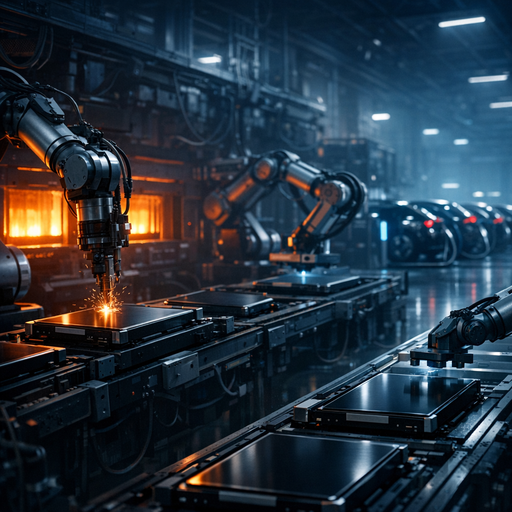

Solid-State Batteries: The Quiet Hardware Shift ML Teams Aren’t Planning For
Why this matters right now
If you run large-scale AI/ML systems, you are in the energy business whether you like it or not.
Three converging trends:
- GPU clusters are becoming power-first, not FLOPS-first: Data centers are hitting power and cooling ceilings before they hit rack space limits. Your next capacity constraint is megawatts, not U.
- EVs and grid storage are about to compete with data centers for the same electrons: As EV fleets and grid-scale batteries scale, they will shape price curves and availability in ways that directly hit training timelines and serving SLAs.
- Solid-state batteries are moving from slideware to pilot lines: Still early, but we’re past “maybe by 2040.” Multiple vendors are committing to late-2020s volume. Not hype-free, but not fiction either.
Why should ML and infra teams care about solid-state batteries?
- They shape when energy is cheap and where it can be reliably buffered.
- They enable distributed, intermittency-tolerant compute patterns (on-prem, at the edge, and within data centers).
- They may change the TCO envelope for scheduling energy-intensive training jobs, especially in regions with volatile renewables.
If your roadmap assumes “grid is always there, price is roughly stable, battery storage is expensive and bulky,” it’s tied to a set of assumptions that are starting to erode.
What’s actually changed (not the press release)
Most coverage of solid-state batteries treats them as magic “twice the range, half the risk” components. That’s wrong in two ways:
- They are not here at scale yet.
- The first real deployments will be constrained, expensive, and application-specific.
Concrete shifts over the last ~3 years:
-
From lab cells to pilot manufacturing lines
- Multiple vendors have demonstrated multi-layer solid-state cells (not just coin cells) with:
- Energy density notably above current Li-ion (20–80% depending on chemistry and conditions).
- Promising cycle life on test rigs.
- The non-trivial part: scaling to thousands/millions of cells with acceptable yield and costs.
- Multiple vendors have demonstrated multi-layer solid-state cells (not just coin cells) with:
-
Automakers have committed aggressive timelines
- Several large OEMs are targeting late-2020s for first commercial EVs with solid-state packs, likely:
- Premium segments only.
- Limited volume, possibly as optional trims.
- These timelines are optimistic and assume manufacturing issues get solved fast.
- Several large OEMs are targeting late-2020s for first commercial EVs with solid-state packs, likely:
-
Grid and stationary storage are quietly experimenting
- Smaller stationary storage players (industrial sites, microgrids) are evaluating solid-state prototypes because:
- Safety (reduced thermal runaway risk) lets them install closer to critical infrastructure.
- Energy density reduces footprint, useful where land is constrained.
- Early units will look more like high-spec UPS replacements than massive grid batteries.
- Smaller stationary storage players (industrial sites, microgrids) are evaluating solid-state prototypes because:
What has not changed:
- We still don’t have:
- Proven, decade-long field data at scale.
- Mature, high-yield manufacturing processes.
- Clear cost curves down to “commodity Li-ion” levels.
If you’re building infrastructure plans to 2030+, the signal is: solid-state is plausible at scale, but timing, cost, and exact performance profile are all uncertain.
How it works (simple mental model)
You don’t need electrochemistry details. Use this mental model:
Classic Li-ion today
- Liquid electrolyte between anode and cathode.
- Pros:
- Mature manufacturing.
- Good cost and energy density.
- Cons:
- Flammable liquid -> thermal runaway risk.
- Limits on how fast you can charge/discharge and at what temperatures.
- Some chemistries (e.g., high nickel) age faster than you’d like.
Solid-state batteries
Swap the liquid electrolyte for a solid electrolyte (ceramic, polymer, or composite).
This changes the game in a few ways:
-
Higher energy density potential
- Solid electrolytes can support lithium metal anodes (very high specific capacity) instead of graphite.
- In practice: you can fit more kWh in the same volume/weight, or the same kWh in less space/weight.
-
Safety envelope
- Solid electrolytes are generally non-flammable.
- This doesn’t make failures impossible, but it:
- Reduces fire risk.
- Expands locations where high-density storage is acceptable (inside buildings, near critical gear).
-
Operating window
- Potentially better thermal stability.
- Some chemistries struggle at low temperatures; others handle heat better but are fragile to mechanical stress.
- In theory, you can push charge/discharge harder. In practice, early designs are conservatively limited to preserve lifetime.
-
Manufacturing complexity
- Everyone’s chasing the sweet spot of:
- Thin solid electrolytes.
- Stable interfaces (no dendrites, no cracking).
- Processes compatible with high-throughput, low-cost production.
- It’s the same kind of challenge as going from a lab semiconductor process to a 300mm fab.
- Everyone’s chasing the sweet spot of:
For planning purposes, treat “solid-state” as:
“A next-gen, higher-density, safer battery that will start expensive, limited, and quirky—and get steadily less quirky and cheaper over a decade, if manufacturing learning curves behave.”
Where teams get burned (failure modes + anti-patterns)
Your risk isn’t about choosing the wrong electrolyte. It’s about locking infra assumptions to an unrealistic energy/storage trajectory.
Failure mode 1: Treating grid constraints as fixed
Pattern:
- Data center planning assumes:
- Stable grid supply, maybe backed by diesel or small Li-ion UPS.
- Minimal role for on-site large-scale storage beyond ride-through.
Why this burns you:
- As EV and grid storage scale, peak pricing and curtailment events get more volatile.
- Solid-state (and next-gen storage generally) make it cheaper and safer to:
- Store energy locally when prices are low or when renewables are overproducing.
- Run heavy training jobs against that stored energy.
If you don’t build for this, you:
- Lose out on arbitrage between time-of-use prices.
- Have fewer options when regulators or grid operators constrain large loads.
Failure mode 2: Betting on a specific timeline
Pattern:
- Internal strategy decks that assume:
- “By 2028, solid-state will halve battery cost and double density.”
- “By 2030, data center UPS will mostly be solid-state.”
Why this burns you:
- These are engineering-optimistic, not manufacturing-optimistic timelines.
- Delays at any of the following choke points push adoption:
- Yield and defect rates at pilot lines.
- Long-duration cycle life proving.
- Safety certifications and insurance ecosystem.
- Supply chain for new materials.
Anti-pattern: Using solid-state assumptions to justify putting off today’s grid and storage work “until it’s better.”
Failure mode 3: Ignoring EV–data center coupling
Pattern:
- Infra teams model power constraints using:
- Current local grid capacity.
- Historical price curves.
- Short-term renewables plans.
Without considering:
- A nearby region’s EV manufacturing or fleet deployment plans.
- The possibility that EV solid-state adoption reshapes regional energy demand profiles.
Why this matters:
- In some regions, EV adoption will:
- Increase overall demand.
- Move load into specific time windows (e.g., after-work charging).
- Solid-state in EVs:
- Enables higher charging rates -> sharper local peaks.
- Increases vehicle range -> changes travel and charging patterns.
Combine that with data center growth and you get competing flexible loads. If you’re not part of the conversation with utilities or regulators, policy may treat your load as less mission critical than you think.
Failure mode 4: Overfitting to “today’s Li-ion annoyances”
Pattern:
- Designing battery-backed systems purely around:
- Current Li-ion thermal issues.
- Current rack and floor space requirements.
- Then assuming “solid-state will magically fix all this; we’ll retrofit later.”
Issue:
- Even with solid-state, you’ll still care about:
- Cycle life under partial charge (common for load balancing).
- Power density vs. energy density trade-offs (fast discharge vs. long backup).
- Management and BMS software for health and safety.
- Integration complexity doesn’t vanish. It morphs.
Practical playbook (what to do in the next 7 days)
You can’t make solid-state appear faster. But you can stop building systems that assume nothing changes.
1. Update your mental model of energy as a product input
For AI/ML infra leads:
- Rewrite your “resources” list for training/serving to explicitly include:
- Energy quantity (kWh) and power (kW).
- Time profile of energy cost (hourly, seasonally).
- Local storage possibilities (on-prem, co-located, or third-party).
Treat energy like you treat compute time and GPU memory: a bounded, schedulable resource.
2. Stress-test your current plan against storage-rich futures
Do a simple scenario exercise with your infra / SRE team:
- Assume:
- Local, safe, high-density storage (solid-state or equivalent) is:
- Available on-prem or at colocation within 10–15 years.
- Cost falls like Li-ion did, but 5–10 years shifted.
- Local, safe, high-density storage (solid-state or equivalent) is:
- Ask:
- Where would we colocate training jobs to exploit cheap, intermittent energy plus storage?
- Which jobs could be:
- Deferrable (run when power is cheapest).
- Interruptible (paused when grid is stressed).
- What would we change in:
- Job schedulers.
- Workload classification (priority, energy flexibility).
- Data locality design.
You don’t need precise solid-state specs; you need architectural elasticity.
3. Start tracking the right signals
Have someone on infra/strategy quietly track:
- Grid-scale battery deployments in your current and planned regions.
- Data center power availability roadmaps from your providers.
- Public timelines from:
- Major battery manufacturers.
- Automakers with heavy solid-state claims.
For each, maintain a simple internal dashboard:
- “If solid-state slips 5 years, how does that affect our:
- Data center siting?
- Use of on-prem vs. cloud?
- ML job mix and scheduling flexibility?”
You’re not forecasting the chemistry; you’re modeling the dependency.
4. Experiment with today’s storage as a proxy
Use existing Li-ion (or even flywheels / supercaps) to trial the behavior you’ll eventually want with solid-state:
- Pilot:
- Running certain training jobs only when on-site battery is > X% and grid price < Y.
- Using storage as an internal “buffer” for micro-outages or demand response.
- Instrument:
- Cost savings or penalties.
- Impact on job completion times and reliability.
- Operational complexity in orchestrators.
Treat this like a feature flag for “energy-aware ML scheduling,” which will become more valuable as storage gets denser and safer.
5. Build energy literacy into your ML and platform teams
Within the next week:
- Run a 1–2 hour brown bag on:
- Data center energy flows.
- Basics of grid-scale and on-prem storage (including rough properties of Li-ion vs. solid-state).
- How their training/serving patterns affect power draw.
- Outcome:
- Engineers and tech leads start including energy and storage in design docs, just like they do latency and SLOs.
Bottom line
Solid-state batteries are not guaranteed, not on-time, and not magic. They are:
- Technical progress that’s already beyond hype-only stage.
- Likely to land first in premium EVs and selected stationary storage where safety and density justify higher initial costs.
- Exactly the kind of underlying shift that quietly reshapes constraints for AI infrastructure over a 10–15 year horizon.
For ML and infra leaders, the key move isn’t to bet on a particular vendor or year. It’s to:
- Stop assuming “power is external and fixed.”
- Architect systems that:
- Can exploit cheaper, denser, safer storage when it appears.
- Can tolerate and monetize variability in energy cost and availability.
- Treat energy as a schedulable and optimizable resource, like GPUs.
If solid-state delivers, you’ll be ready to plug it in—literally and architecturally.
If it slips or underperforms, the same work positions you better for whatever storage technology wins.
In both cases, ignoring it is the riskiest option.