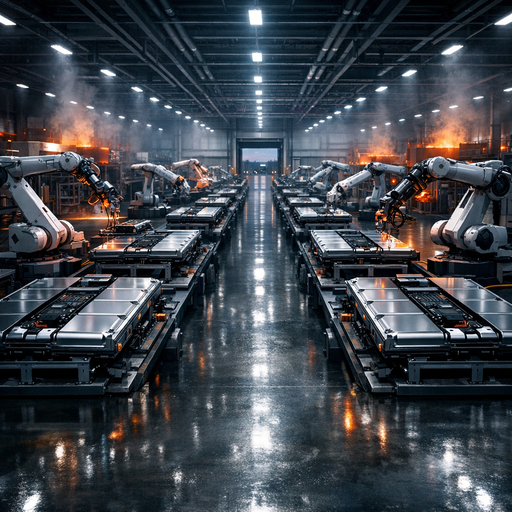
Solid-State Batteries Are Leaving the Lab. Here’s What Matters for People Who Ship Hardware

Why this matters this week
Three things quietly shifted in the last few weeks that matter if you build or buy EVs, stationary storage, or battery-powered equipment:
- Multiple OEMs and cell makers have moved from “solid-state by 2030” slideware to explicit pilot-line volumes and dated SOP (start of production) for hybrid solid-state or “semi-solid” architectures.
- A few governments (notably in East Asia and the EU) have begun tying subsidies and procurement to domestic solid-state battery manufacturing, not just generic lithium-ion.
- Several EV and grid-storage roadmaps I’ve seen (from readers and clients) still implicitly assume today’s NMC/graphite cells for the next 10–15 years, with no design hooks for higher-voltage, higher-energy-density packs.
If you’re responsible for architecture, reliability, or capex planning, solid-state batteries are no longer a 2040 science project. They’re a medium-term risk/opportunity that can either:
- Blow up your cost and qualification assumptions in 3–7 years, or
- Drop into a roadmap you’ve already designed for with minimal drama.
This post is about giving you a realistic, engineering-first picture of commercial solid-state progress, constraints, and what to do this quarter—not “the battery of the future” hype.
What’s actually changed (not the press release)
You’ve seen the headlines: “2x energy density,” “10-minute charging,” “no fire risk.” Most are extrapolations from coin cells or tiny pouch cells.
Here’s what’s actually true in 2024–2025, with rough numbers.
1. Scale is moving from coin cells → A-samples → pilot lines
Across the industry (Japan, Korea, China, US/EU), the pattern is:
- Coin and small pouch cells (tens of mAh to a few Ah) at TRL 5–6
- Lab and limited pre-production.
- Often show great energy density and cycling at limited C-rates.
- A-sample EV cells (10–30 Ah) at TRL 6–7
- Now being built on pilot lines.
- Performance is promising but not yet matching the headline lab data.
- Early pilot lines
- Throughputs in the low MWh/year to maybe low GWh/year.
- Yields are low and process windows tight (temperature, pressure, humidity).
If you’re hearing dates like “mass production in 2027,” what’s usually meant is:
- Automotive qualification volumes in the hundreds of MWh/year,
- For select, high-margin models first (flagship EVs, performance trims),
- With conservative specs vs marketing slides.
2. Not all “solid-state” is the same
Three main camps are emerging, each with different trade-offs:
-
Polymer-based (often called “solid-state,” but really soft/gel-like):
- Pros: Lower-temperature processing, some compatibility with existing equipment.
- Cons: Limited high-temperature performance; ionic conductivity is okay but not spectacular.
- Commercialization: Sooner, but performance step vs today’s liquid Li-ion is incremental.
-
Sulfide-based ceramic electrolytes:
- Pros: High ionic conductivity, good interface with high-capacity cathodes.
- Cons: Moisture-sensitive (forms H₂S), requires careful handling and encapsulation.
- Commercialization: Active focus for EVs; a likely candidate for early premium adoption.
-
Oxide-based ceramics (e.g., garnet-type):
- Pros: More chemically stable, good safety potential.
- Cons: Difficult to process into thin, defect-free layers; high interfacial resistance.
- Commercialization: Slower, but attractive for safety-critical and stationary storage long term.
Marketing often collapses these into a single “solid-state battery” category, but your thermal, mechanical, and safety design implications differ substantially between them.
3. Timelines: realistic, not marketing
Aggregating what’s publicly stated and what’s being quietly planned by OEMs:
- 2025–2027:
- Low-volume, premium EV integrations with semi solid-state or hybrid solid+liquid designs.
- Stationary pilots where cycle life and safety matter more than cost.
- 2028–2032:
- First significant volumes in high-end EVs and possibly buses or trucks on fixed routes.
- Grid applications where higher temperature tolerance and safety are valued enough to pay the premium.
- >2032:
- Potential cost parity with advanced Li-ion (high-nickel, LFP+additives) if yields and throughput improve.
If you’re designing products for release in 2027–2030, you can’t count on commoditized, cheap solid-state cells—but you can assume niche availability for flagship SKUs or specialized storage use-cases.
4. Safety is better, but not “problem solved”
Solid electrolytes reduce liquid flammables and can mitigate thermal runaway propagation. However:
- Interface layers, binders, and packaging can still include organic components that burn.
- Mechanical damage (cracks, voids) can create hotspots and local shorting.
- Abuse conditions (crush, nail penetration, external heating) still need serious testing.
Anyone integrating these assuming “no BMS constraints” or “no thermal management needed” will get burned—possibly literally.
How it works (simple mental model)
Keep a mental model with four layers: anode, solid electrolyte, cathode, and interfaces.
-
Anode: often lithium metal (the big win)
- Today’s Li-ion typically uses graphite or Si-graphite anodes.
- Solid-state aims to use lithium metal:
- Much higher specific capacity → higher energy density.
- But: dendrites (needle-like lithium growth) can short the cell if not controlled.
-
Solid electrolyte: the key differentiator
- Replace flammable liquid with a solid medium:
- Polymer, sulfide ceramic, oxide ceramic, or hybrids.
- Needs:
- High ionic conductivity (like a liquid).
- Low electronic conductivity (avoid shorting).
- Mechanical strength to suppress dendrites.
- Think of it as a thin, brittle “ceramic separator” that must be nearly defect-free.
- Replace flammable liquid with a solid medium:
-
Cathode: similar chemistries, different packaging
- Often still high-nickel NMC or related materials.
- Challenge: ensuring intimate contact between cathode particles and solid electrolyte:
- Volume changes during cycling can break contact.
- Result: rising impedance, capacity fade.
-
Interfaces: where most failure happens
- A thin interphase layer often forms at both anode–electrolyte and cathode–electrolyte boundaries.
- This layer can be:
- Helpful (stable SEI-like protection), or
- Harmful (resistive, unstable, grows over time).
- Much of the “secret sauce” is in how materials and processes manage these interphases.
If you remember nothing else: solid-state is less about a magic new material and more about precision manufacturing of interfaces and keeping them intact over thousands of cycles.
Where teams get burned (failure modes + anti-patterns)
1. Believing lab cell performance will map directly to pack-level
Common failure pattern:
- Lab: 1 mAh coin cell, 2C charge, 1000 cycles, great retention.
- Pack: 60–100 kWh, varied C-rates, non-uniform temperature distribution, mechanical stresses.
What goes wrong:
- Slight misalignment or pressure variation across large-format cells → local contact loss → hotspots → early degradation.
- Mechanical stack tolerances that are fine for Li-ion become too loose for brittle solid layers.
Mitigation:
- Require pack-level and module-level test data, not just coin-cell graphs.
- Design test programs specifically for:
- Pressure non-uniformity.
- Vibration and mechanical shock.
- Temperature gradients across modules.
2. Underestimating manufacturing constraints
Real-world example pattern (anonymized):
- A mid-sized EV startup penciled in solid-state pack costs assuming “similar to Li-ion plus 20%.”
- Actual pilot data: yields below 60%, slow deposition steps, stricter dry-room needs.
- Result: effective cell cost >2× equivalent Li-ion at their volumes.
Manufacturing traps:
- Defect sensitivity: pinholes and microcracks in solid electrolytes are far more catastrophic than minor separator flaws in liquid systems.
- Throughput limits: sintering or specialized coating steps may be rate-limiting.
- Tooling costs: existing Li-ion lines are only partially reusable, depending on chemistry.
If your roadmap assumes specific $/kWh from a vendor, demand:
- Yield curves vs time.
- Process flow with bottlenecks called out.
- Sensitivity analysis around material price and line capex.
3. Over-rotating on “no cooling, no BMS”
Some product teams assume:
- Solid-state → inherently cool and safe → passive cooling + bare-minimum BMS.
This leads to:
- Packs that pass early tests but fail accelerated aging.
- Hidden hotspots in high-power charge/discharge profiles.
- Limited ability to detect internal defects because of less mature BMS models.
Treat early solid-state packs as demanding more nuanced thermal and electrical management, not less:
- Thermal design: still assume active management for EVs and high-C stationary storage.
- BMS: incorporate more conservative margins initially until field data improves.
4. Ignoring supply chain concentration
For the next 5–10 years, solid-state materials (especially specific sulfide or oxide electrolytes) will have concentrated supply chains:
- Few suppliers, often in specific regions.
- IP-entangled: certain manufacturing routes locked behind patent fences.
If you’re in a regulated or security-sensitive environment (national labs, critical infrastructure), this matters:
- Higher risk of export controls, trade disputes, or single-point dependency.
- Harder dual-sourcing.
Build this into risk models just as you do for current cathode and precursor materials.
Practical playbook (what to do in the next 7 days)
You can’t turn your stack into a battery lab in a week, but you can sanity-check your plans and create optionality.
1. Audit your roadmaps and assumptions
For each EV or stationary program:
- Locate where you’ve implicitly assumed:
- Specific energy plateaus for 10+ years.
- Pack form factors locked to current cell geometries.
- Cooling and BMS architectures tuned only to liquid Li-ion behaviors.
- Ask: “If cells with ~30–50% higher energy density and better abuse tolerance become available in 2030, how hard would it be to adopt them?”
You don’t need detailed designs now—just mark whether adoption is “trivial,”